
DJI Mic Mini 2S vs Hollyland LARK M2S: Best Wireless Mic for Creators in 2026?

The DJI Mic Mini 2S and Hollyland LARK M2S are two of the most compelling compact wireless microphone systems for creators in 2026, but they are designed around different priorities.
The DJI Mic Mini 2S is the better choice for creators who want internal 32-bit float backup recording, integration with compatible DJI cameras and support for more advanced multi-person productions.
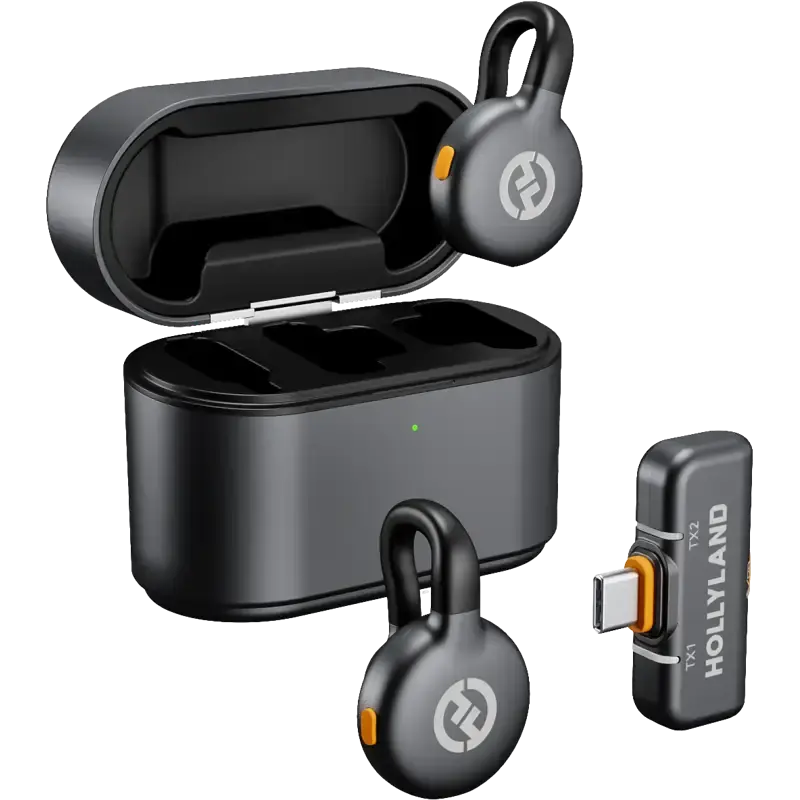
The Hollyland LARK M2S is the better-value choice for creators who want an exceptionally small, discreet microphone that works with phones and cameras without drawing attention to itself on screen.
Here is the short recommendation:
Choose the DJI Mic Mini 2S if recording security matters most. Its internal recording provides a backup if the wireless signal is interrupted or the level sent to your camera is incorrect.
Choose the Hollyland LARK M2S if appearance, weight and value matter most. Its 7-gram, logo-free transmitter is less distracting on clothing and costs less than the DJI system in comparable entry configurations.
Neither is universally better. The right microphone depends on whether you record with a smartphone, camera or DJI device; whether you film one or several people; and whether internal backup recording is essential to your work.
You can compare the available kits in Standesk’s Streaming and Recording Gear collection.
DJI Mic Mini 2S vs Hollyland LARK M2S: Quick Verdict
The most important difference is straightforward:
The DJI Mic Mini 2S is the safer production tool. The Hollyland LARK M2S is the more discreet value choice.
DJI’s new system can record audio internally in 24-bit or 32-bit float format. If the transmitted signal clips, drops out or is recorded incorrectly by the connected camera, the transmitter may still contain a usable recording.
The LARK M2S sends high-quality 24-bit/48 kHz audio wirelessly, but it does not provide the same internal recording safety net. Its advantages are its smaller transmitter, inconspicuous logo-free design, titanium clip and lower price.
Choose the DJI Mic Mini 2S if you:
Record paid interviews, events or client work where losing audio would be costly.
Want internal 32-bit float backup recording.
Frequently record people whose speaking volume changes unexpectedly.
Already use compatible DJI Osmo cameras.
May eventually need three- or four-person recording.
Want compatibility with existing DJI Mic Mini or Mic Mini 2 transmitters.
Prefer a system with a more expandable recording workflow.
Choose the Hollyland LARK M2S if you:
Want the microphone to be as unobtrusive as possible on camera.
Create YouTube videos, TikToks, Instagram Reels or online courses.
Record interviews with one or two speakers.
Need a lightweight microphone for long filming sessions.
Switch between a USB-C phone and a conventional camera.
Do not require internal backup recording.
Want strong everyday performance at a lower price.
Consider the Hollyland LARK A1 if you:
Record primarily with a smartphone.
Want the least expensive entry point.
Do not need a conventional camera receiver.
Prefer direct access to noise cancellation, gain, EQ and reverb controls.
Need a simple microphone for short-form videos, calls or beginner content creation.
The Hollyland LARK A1 is not a direct replacement for the DJI Mic Mini 2S, but it is a relevant budget alternative for smartphone-first creators.
Consider the Hollyland LARK M2 if you:
Like the compact button-style transmitter.
Want a versatile phone-and-camera system.
Prefer a longer total battery life than the LARK M2S.
Do not need the M2S model’s titanium clip and nearly invisible appearance.
The Hollyland LARK M2 sits between the affordable LARK A1 and the more discreet LARK M2S.
DJI Mic Mini 2S and Hollyland LARK M2S Compared
Feature | DJI Mic Mini 2S | Hollyland LARK M2S |
Best for | Recording security and expandable creator workflows | Discreet filming and strong value |
Transmitter weight | Approximately 12 g | Approximately 7 g |
Audio format | 24-bit or 32-bit float internal recording | 24-bit/48 kHz wireless audio |
Internal recording | Yes | No |
Internal storage | Approximately 14.5 GB | Not applicable |
Maximum stated range | Up to 400 m with the standard receiver | Up to 300 m line of sight |
Noise reduction | Two-level AI noise cancellation | Environmental Noise Cancellation |
Voice controls | Three voice-tone presets | Adjustable through supported controls and app |
Maximum transmitters | Up to four with a compatible DJI receiver | Two in standard dual-transmitter kits |
Direct ecosystem connection | Compatible DJI OsmoAudio devices | Not applicable |
Smartphone support | USB-C, Lightning with the appropriate adapter, or supported Bluetooth workflows | USB-C or Lightning, depending on bundle |
Camera support | Standard receiver and 3.5 mm connection | Camera receiver in selected bundles |
Transmitter battery | Up to approximately 11 hours under stated conditions | Approximately 9 hours |
Total battery with case | Up to approximately 40 hours for the relevant Mini 2S kit | Up to approximately 30 hours |
On-camera appearance | Compact, but still recognisable as a transmitter | Smaller, logo-free and particularly discreet |
Main limitation | Higher price and more features than some beginners need | No internal safety recording |
Standesk price shown at publication | From €105.99, depending on kit | From €84.88, depending on bundle |
Manufacturer range and battery figures are measured under controlled conditions. Walls, people, Wi-Fi congestion, receiver placement, noise cancellation and recording settings can reduce real-world performance.
Prices can also change and should only be compared after checking what each bundle contains. A one-transmitter smartphone kit is not equivalent to a two-transmitter camera kit with a charging case.
Which Wireless Microphone Is Better Overall?
The DJI Mic Mini 2S is the more capable system overall.
Internal recording is the decisive advantage. A wireless microphone’s job is not merely to sound good when everything works correctly. It must also protect the recording when something goes wrong.
A transmitted recording can be affected by:
Wireless interference.
Incorrect camera gain.
Accidental receiver disconnection.
Sudden changes in speaking volume.
Clipping caused by shouting or laughter.
A creator moving beyond reliable reception range.
A camera operator forgetting to monitor the incoming level.
The DJI transmitter can store an internal recording independently from the audio sent to the receiver. That makes the Mic Mini 2S easier to recommend for weddings, interviews, documentaries, events and paid client work.
However, “better overall” does not mean “better for everyone.”
A solo creator recording talking-head videos at home may never need four transmitters, internal files or a complex recovery workflow. That creator may receive more practical value from the lighter LARK M2S.
The Hollyland model is especially attractive when the microphone remains visible throughout the video. A large branded transmitter can distract viewers, interfere with clothing or make an otherwise polished production look less natural. The LARK M2S was designed specifically to reduce that problem.
Our overall verdict is therefore:
DJI Mic Mini 2S wins for capability and recording security.
Hollyland LARK M2S wins for discretion, simplicity and value.
Why This Comparison Matters in 2026
Wireless creator microphones are changing quickly.
The earliest compact systems mainly replaced a cable between the person speaking and the camera. Newer models are becoming complete recording systems with internal storage, intelligent noise reduction, automatic limiting, app control and direct connections to cameras or smartphones.
The DJI Mic Mini 2S represents that transition particularly well. DJI introduced the model in September 2026 as a compact wireless microphone with internal 32-bit float recording, AI noise cancellation and integration with its OsmoAudio ecosystem.
That combination matters because internal recording was previously one of the most obvious compromises made by many small and affordable wireless microphones.
Creators often had to choose between two categories:
A tiny, convenient microphone with limited backup protection.
A larger or more expensive professional system with internal recording.
The Mic Mini 2S narrows that gap. It remains small enough for mobile creation while adding a feature normally associated with more serious production systems.
The LARK M2S approaches the same market from another direction. Instead of concentrating on internal recording, Hollyland prioritises a nearly invisible transmitter, a titanium clip and straightforward phone-and-camera compatibility.
This produces a meaningful choice rather than a comparison between two nearly identical products.
How We Prepared This Comparison
Standesk compared the two microphone systems using:
Current manufacturer specifications.
Official compatibility information.
Available receiver and transmitter configurations.
Recording formats and storage capabilities.
Battery and wireless-range claims.
Smartphone, camera and ecosystem compatibility.
Physical design and transmitter weight.
The needs of different creator workflows.
Current Standesk pricing and bundle availability.
This is a specification- and use-case-based buying guide. It does not present laboratory measurements or claim that Standesk performed controlled audio testing when no such test was conducted.
Range and battery specifications should not be treated as guaranteed real-world results. Manufacturer range figures are normally recorded in open, interference-free environments. Actual performance can be lower in cities, exhibition halls, offices and other locations with physical obstructions or heavy wireless traffic.
Transparency: Standesk sells the microphones discussed in this guide. Recommendations are based on features and use cases rather than selecting the most expensive product as the automatic winner.
What Do the DJI Mic Mini 2S and Hollyland LARK M2S Have in Common?
Both products solve the same central problem: a phone or camera is often too far away to record a clear voice.
A camera-mounted or smartphone microphone captures more room sound as the speaker moves away. Reflections, traffic, wind and nearby conversations become more noticeable, while the intended voice sounds increasingly distant.
A small wireless transmitter stays close to the speaker’s mouth. This generally produces a clearer and more consistent voice than relying on a phone’s built-in microphone from several metres away.
Both systems provide:
Small clip-on transmitters.
Omnidirectional voice capture.
Wireless transmission.
Noise-reduction functions.
Smartphone recording options.
Camera-compatible configurations.
Kits suitable for one- or two-person recording.
Charging options designed for portable use.
Plug-and-play operation for common workflows.
Windscreens for outdoor recording in relevant kits.
Both can work well for:
YouTube videos.
TikTok and Instagram content.
Interviews.
Vlogging.
Online courses.
Presentations.
Product demonstrations.
Travel videos.
Corporate content.
Mobile journalism.
Wedding and event filming.
Remote teaching.
The differences become important when the recording cannot be repeated, the microphone must remain inconspicuous or the creator uses several cameras and mobile devices.
The Biggest Difference: Internal 32-Bit Float Recording
What internal recording means
With conventional wireless recording, the transmitter captures the voice and sends it to a receiver connected to a phone, camera or computer. The final recording depends on that wireless link and the receiving device.
Internal recording creates another copy inside the transmitter.
If the camera file contains interference or incorrect levels, the creator can retrieve the internally recorded version and synchronise it during editing.
This does not eliminate every possible audio problem. A microphone placed badly under clothing can still sound muffled, and wind can still overload an exposed capsule. Internal recording nevertheless protects against several failures that would otherwise ruin an important take.
Why 32-bit float matters
The DJI Mic Mini 2S supports internal 32-bit float recording.
The practical advantage is additional flexibility when a voice changes dramatically in volume. A creator may speak quietly and then suddenly laugh, shout or move the microphone closer to their mouth. A conventional recording can clip if the level is set too high.
A properly captured 32-bit float file provides much more room to recover those level changes during editing. It reduces the need to choose one conservative gain setting for an unpredictable performance.
It is especially useful for:
Weddings and live events.
Street interviews.
Documentaries.
Fitness and sports content.
Presenters with highly dynamic voices.
Productions without a dedicated sound operator.
Recordings that cannot easily be repeated.
However, 32-bit float does not automatically make a microphone sound better. It improves recording headroom and recovery flexibility; it does not correct poor microphone placement, clothing noise, heavy wind or an unintelligible speaker.
How much internal recording does the DJI provide?
DJI specifies approximately 14.5 GB of built-in storage in each Mic Mini 2S transmitter.
That provides approximately:
28 hours of internal 24-bit recording.
22 hours of internal 32-bit float recording.
The exact available duration can vary with settings and file management.
Internal 32-bit float recording is not necessarily enabled by default. Creators should configure the feature through the supported DJI workflow before relying on it during an important shoot.
Does the Hollyland LARK M2S record internally?
No. The LARK M2S transmits 24-bit/48 kHz audio to the connected receiver, phone or camera, but it does not offer the DJI model’s internal backup recording.
That does not make the Hollyland unsuitable for normal content creation. Many YouTube videos, social posts, online lessons and controlled interviews are recorded successfully without an internal transmitter file.
It does mean that creators should monitor levels, confirm the receiver connection and record a short test before beginning.
For paid work or unrepeatable moments, the absence of internal recording is the LARK M2S’s most important limitation.
Is the DJI Mic Mini 2S Worth Paying More For?
The DJI is worth the additional cost when its internal recording can protect work that has real financial or emotional value.
Consider how expensive an audio failure would be.
If a creator can simply record another thirty-second product introduction, internal backup may be convenient rather than essential. If the recording contains wedding vows, a one-time interview or a client presentation, the backup can justify the price difference immediately.
The DJI premium is easier to justify for:
Professional videographers.
Wedding filmmakers.
Event producers.
Journalists.
Documentary creators.
Agencies recording client content.
Creators using compatible DJI cameras.
Teams expecting to expand beyond two speakers.
The LARK M2S remains the more rational purchase for many solo creators. Paying for recovery features that never enter the workflow does not necessarily improve the published video.
Budget should also include the correct bundle, not only the lowest advertised product price. Before ordering, confirm:
How many transmitters are included.
Whether the receiver is intended for a camera or smartphone.
Whether a charging case is included.
Whether the required USB-C or Lightning connection is included.
Whether additional adapters are necessary.
The DJI Mic Mini 2S is available from Standesk in Mobile Creator and Creator & Camera configurations.
The Hollyland LARK M2S is available in several USB-C, Lightning and camera-oriented bundles.
Sound Quality: Which Wireless Microphone Sounds Better?
Both the DJI Mic Mini 2S and Hollyland LARK M2S capture voice at a level suitable for YouTube, interviews, social media, online courses and professional business content.
Neither microphone can be declared the universal sound-quality winner from specifications alone. The final result depends heavily on:
Microphone placement.
Distance from the speaker’s mouth.
Clothing and fabric noise.
Wind protection.
Input gain.
Noise-reduction settings.
The speaker’s voice.
The room or outdoor environment.
Processing applied during editing.
Both systems are capable of producing clear, usable dialogue when placed correctly. The more meaningful difference is how each system manages unpredictable recording conditions.
DJI Mic Mini 2S sound profile
The DJI Mic Mini 2S records internal audio in 24-bit or 32-bit float format and offers three voice-tone presets through supported DJI controls.
These presets allow creators to select a presentation that better suits their voice or production style. They can be useful for creators who want a more polished result without building a complicated audio-processing chain.
DJI also provides adaptive gain and automatic limiting features intended to reduce the risk of unusable levels.
The key advantage is not necessarily that the DJI microphone will always sound more natural. It is that the complete system gives the creator more ways to protect and adjust the recording.
A creator can potentially work with:
The signal transmitted to the camera or phone.
An internal 24-bit recording.
An internal 32-bit float recording.
Different voice-tone settings.
Adjustable noise cancellation.
Automatic limiting or adaptive gain.
This flexibility makes the DJI model more forgiving when recording conditions change quickly.
Hollyland LARK M2S sound profile
The Hollyland LARK M2S captures 24-bit/48 kHz audio with an omnidirectional microphone.
Its sound is intended for clear spoken content rather than music recording or cinematic ambience. The microphone stays close to the speaker, helping it produce a more direct voice than a phone or camera microphone positioned farther away.
For controlled recordings, this can be all many creators need.
The LARK M2S is particularly appropriate for:
Talking-head YouTube videos.
Tutorials.
Social-media content.
Product demonstrations.
Presentations.
Online teaching.
Interviews in reasonably controlled locations.
Everyday business recording.
Its main sound-related limitation is not the 24-bit format. Properly recorded 24-bit dialogue is more than adequate for professional online video. The limitation is the absence of a separate internal file if the transmitted recording fails.
Will 32-bit float sound better than 24-bit audio?
Not automatically.
A well-recorded 24-bit voice can sound just as good in the finished video as a 32-bit float recording. Viewers will not hear a special “32-bit float sound.”
The benefit appears when levels go wrong.
If a speaker suddenly becomes much louder, a conventional recording may clip. If the DJI transmitter captured an unclipped 32-bit float internal file, the editor may be able to reduce the level and recover the moment.
The feature is therefore about protection and dynamic range rather than an automatic improvement in tone.
For predictable speech recorded in a controlled environment, the LARK M2S’s 24-bit audio can be entirely sufficient.
For unpredictable speech or unrepeatable events, the DJI’s internal 32-bit float recording is more valuable.
Noise Cancellation: DJI AI Noise Cancelling vs Hollyland ENC
Both microphones include noise-reduction technology, but neither can completely isolate a voice from every environment.
Noise cancellation can help reduce steady background sounds such as:
Air conditioning.
Computer fans.
Road noise.
Crowd ambience.
Low-level wind.
Continuous mechanical noise.
General room noise.
It is less effective against irregular sounds such as:
Another person speaking nearby.
Sudden traffic horns.
Dishes or tools being dropped.
Clothing rubbing directly against the microphone.
Strong wind striking the capsule.
Music playing close to the speaker.
Good placement and wind protection remain more important than the name of the noise-cancellation system.
DJI Mic Mini 2S noise cancellation
The DJI Mic Mini 2S provides two selectable levels of AI noise cancellation.
A lighter setting is generally more appropriate when the environment is moderately noisy and the creator wants to preserve a natural voice. A stronger setting can be useful in challenging locations, but aggressive processing may make speech sound less natural.
DJI allows the noise-reduction level to be controlled through compatible devices or the DJI Mimo app, depending on the connection method.
An important detail is that processing may affect the transmitted signal and internal recording differently, depending on the selected internal file type. Creators should confirm whether they are saving an original or processed internal file before recording.
For professional work, retaining an unprocessed internal recording can be useful because the editor can apply noise reduction later with more control.
Hollyland LARK M2S Environmental Noise Cancellation
The LARK M2S uses Environmental Noise Cancellation to reduce unwanted background sound in real time.
Its straightforward operation suits creators who want to record and publish quickly without detailed audio editing. This is valuable for social content, interviews, online courses and business videos where speed matters more than extensive post-production.
Noise cancellation should still be used selectively. A very strong setting can remove parts of a voice along with the background noise, especially when the speaker is quiet or the microphone is poorly positioned.
Which microphone is better in noisy environments?
The DJI Mic Mini 2S offers the more flexible workflow because it combines adjustable AI noise cancellation with internal recording options.
The Hollyland LARK M2S remains capable of handling normal environmental noise, but there is less room to recover a compromised recording afterward.
For a busy trade show, wedding reception or unpredictable outdoor interview, the DJI is the safer recommendation.
For a quiet office, home studio, classroom or controlled talking-head recording, the practical difference may be much smaller.
Design and Visibility on Clothing
Design is one of the LARK M2S’s strongest advantages.
Many wireless microphone transmitters are easy to notice. They may have a large square body, a visible logo or a clip that pulls on lightweight clothing. This is acceptable for casual content, but it can be distracting in professional interviews, weddings, documentaries and corporate productions.
Hollyland LARK M2S: the more discreet microphone
The LARK M2S transmitter weighs approximately 7 grams and uses a logo-free design with a titanium clip.
Instead of presenting a large branded surface toward the camera, the visible portion is intended to blend more naturally into clothing. The compact transmitter is also less likely to pull down a thin shirt or remain uncomfortable during a long recording session.
This makes it particularly suitable for:
Wedding filmmakers.
Corporate interviews.
Documentaries.
Presenters wearing formal clothing.
Educational videos.
Journalists.
Property tours.
Beauty and fashion creators.
Videos where visual presentation is important.
The titanium clip is also useful when the speaker moves. A microphone that changes position or falls from clothing can produce inconsistent audio even if its electronics work perfectly.
DJI Mic Mini 2S: compact but more recognisable
At approximately 12 grams, the DJI transmitter is still very light. It is suitable for everyday clothing and should not be confused with the much larger transmitters used by older professional wireless systems.
However, it remains more visible than the LARK M2S.
DJI offers interchangeable magnetic front covers, allowing creators to modify the transmitter’s appearance. This adds personalisation, but it does not make the microphone as visually unobtrusive as Hollyland’s logo-free design.
The DJI model is well suited to modern creator content where viewers already expect to see a wireless transmitter. For vlogs, reviews, travel content and casual interviews, its appearance is unlikely to be a serious disadvantage.
Which microphone looks better on camera?
Choose the Hollyland LARK M2S when you want viewers to pay as little attention as possible to the microphone.
Choose the DJI Mic Mini 2S when recording protection and features are more important than making the transmitter almost invisible.
For formal productions, the Hollyland design can produce a cleaner visual result. For unpredictable professional work, the DJI’s larger but still compact transmitter may be an acceptable trade-off for internal recording.
Smartphone Compatibility
Both systems can be used for smartphone content, but the exact experience depends on the selected receiver and phone.
A creator should never assume that every box contains every required connector.
Before purchasing, check:
Whether the phone uses USB-C or Lightning.
Whether the kit includes a mobile receiver.
Whether the native camera application accepts audio from the selected connection.
Whether the phone can charge while the receiver is attached.
Whether the case fits around the connected receiver.
Whether one or two transmitters can be used.
Whether Bluetooth or a physical receiver will be used.
DJI Mic Mini 2S with smartphones
The DJI system supports smartphones through compatible USB-C or Lightning receiver arrangements and through selected Bluetooth workflows.
Using the correct physical receiver is generally the more dependable option for content creation. It provides a clear connection path and avoids some of the application restrictions associated with direct Bluetooth recording.
DJI states that a transmitter connected directly to a smartphone over Bluetooth may not work with the phone’s native camera application. Compatible third-party applications may be required.
Direct Bluetooth also supports only one transmitter connected to the smartphone at a time.
This matters for creators who expect to open the default camera app and immediately record a two-person interview. The required workflow may be different.
The mobile receiver can provide more predictable application support and allow the connected phone and receiver to receive power through the receiver’s USB-C charging port in supported configurations.
Hollyland LARK M2S with smartphones
Hollyland offers dedicated mobile and combination packages for USB-C and Lightning devices.
The mobile receiver connects directly to the phone, creating a straightforward plug-and-play workflow. Selected bundles also include a camera receiver, allowing the same microphones to be used across multiple recording devices.
The available Standesk configurations include options intended for:
USB-C smartphones and tablets.
Cameras and USB-C devices.
Lightning and USB-C workflows.
Creators switching between phones and conventional cameras.
This bundle flexibility is one reason the LARK M2S is attractive to creators who do not use DJI cameras.
Which is better for iPhone?
For a newer USB-C iPhone, either microphone can be a good choice with the correct USB-C receiver.
For an older Lightning iPhone, verify that the necessary receiver or adapter is included. Do not rely only on the microphone name.
The LARK M2S is the stronger value recommendation for straightforward iPhone content when a compatible mobile bundle contains everything required.
The DJI Mic Mini 2S becomes more attractive if the creator wants internal recording or also uses compatible DJI equipment.
Which is better for Android?
Both systems can work well with compatible USB-C Android devices.
Android compatibility can differ between phone manufacturers and recording applications, so creators should confirm support for their exact device. A USB-C port alone does not guarantee that every recording application will select an external microphone correctly.
The Hollyland is particularly compelling for a simple, compact Android setup. The DJI is preferable when internal files and a more expandable ecosystem justify the additional cost.
Camera Compatibility
Creators using mirrorless, DSLR or video cameras should choose a package containing the appropriate camera receiver and 3.5 mm audio cable.
A mobile-only receiver is not a complete substitute for a camera receiver.
DJI Mic Mini 2S with cameras
The standard DJI receiver can connect to a camera through a 3.5 mm audio connection.
DJI also supports direct wireless integration with selected OsmoAudio products. Compatible cameras can receive audio without a separate receiver, reducing cables and the number of devices attached to the camera.
This is one of the DJI system’s most important advantages for creators who already use compatible DJI equipment.
Direct ecosystem integration can simplify:
Camera setup.
Audio monitoring.
Noise-cancellation control.
Multi-device creator kits.
Travel filming.
Gimbal or action-camera workflows.
Compatibility should still be checked for the exact camera. “DJI compatibility” does not mean that every DJI camera supports every transmitter or every number of simultaneous microphones.
Hollyland LARK M2S with cameras
Selected LARK M2S bundles include a camera receiver with USB-C and 3.5 mm audio output.
This conventional approach works well for creators using cameras from different manufacturers. It does not depend on a proprietary camera ecosystem and can therefore be easier to move between different productions.
The Hollyland may be the more flexible practical choice for someone who uses:
A Sony camera for client work.
A Canon or Nikon camera for interviews.
A smartphone for social media.
A laptop or tablet for online presentations.
The correct combination bundle can support several of these workflows without tying the creator to one camera brand.
Which is better for cameras?
Choose the DJI Mic Mini 2S for compatible DJI cameras or when internal recording is important.
Choose the Hollyland LARK M2S for a conventional camera-and-phone workflow where discreet transmitters and value matter more than internal backup.
Wireless Range and Connection Reliability
DJI specifies a maximum transmission range of up to 400 metres between the Mic Mini 2S transmitter and standard receiver under open, unobstructed and interference-free conditions.
Hollyland specifies up to 300 metres line of sight for the LARK M2S.
These numbers are useful for comparing the systems under similar laboratory conditions, but they should not be treated as normal working distances.
Real recording locations may contain:
Walls.
People standing between transmitter and receiver.
Cars and buildings.
Wi-Fi networks.
Bluetooth devices.
Metal structures.
Event-production equipment.
Mobile-network activity.
The creator’s own body blocking the signal.
A microphone can experience interference at a fraction of its advertised maximum distance when the environment is difficult.
Does the DJI’s longer stated range matter?
It can matter for outdoor filmmaking, event coverage, fitness content and situations where the subject moves far from the camera.
For normal interviews, vlogs and talking-head videos, both systems provide far more theoretical range than most creators need.
Connection security depends on more than the maximum number printed on the box. Correct receiver placement, clear line of sight and local wireless congestion can matter more.
The DJI’s internal recording offers an additional layer of protection. Even when the wireless signal becomes unreliable, the transmitter may continue storing the local audio file.
The LARK M2S does not have that independent backup. Staying within a conservative working distance is therefore more important.
Practical range recommendation
Do not plan an important recording around the maximum advertised range.
For critical production:
Keep the receiver visible to the transmitter where possible.
Avoid placing the receiver behind large metal objects.
Do not bury the transmitter beneath heavy clothing.
Monitor the recording with headphones when the receiver supports it.
Record a range test at the actual location.
Enable internal recording on the DJI before filming.
Reduce the working distance in crowded wireless environments.
Battery Life and Charging
Both systems are designed to last through normal creator sessions, interviews and travel shoots.
The difference is unlikely to matter for a short video. It becomes more relevant during weddings, conferences, long interviews and full-day production.
DJI Mic Mini 2S battery life
DJI states approximately:
Up to 11 hours for a transmitter.
Up to 10 hours for the standard receiver.
Up to 40 hours of total operation with the relevant charging case.
These results depend on settings and controlled test conditions. Internal recording, noise cancellation, transmission distance, temperature and repeated device interaction can affect actual endurance.
DJI also states that approximately five minutes of charging can provide up to one hour of operating time under specified conditions. This can be useful during a long production when a transmitter is nearly empty.
Hollyland LARK M2S battery life
Hollyland states approximately:
Nine hours from an individual transmitter.
Up to 30 hours of total operation with the applicable charging case.
That is sufficient for most social content, interviews, courses and normal filming days.
A creator should still return the microphones to the charging case during breaks. Small transmitters are easy to leave switched on accidentally, particularly during productions involving several people.
Which microphone has better battery life?
The DJI Mic Mini 2S has the advantage based on the manufacturers’ stated figures.
Its advantage is useful for longer shoots, but neither system should require constant charging during ordinary creator use.
The bundle remains important. A kit without a charging case will not provide the same total operating time as the complete case configuration.
Recording One, Two or Four People
The number of speakers is one of the easiest ways to choose the correct system.
Solo creators
A one-transmitter kit is sufficient for:
Solo vlogging.
Product reviews.
Tutorials.
Voice-led travel videos.
Online courses.
Fitness instruction.
Business presentations.
A second transmitter is useful only if the creator expects to add guests or wants a spare microphone ready.
For a solo smartphone creator, the Hollyland LARK A1 or a single-person DJI configuration may be more economical than a complete two-transmitter camera kit.
Two-person interviews
Both the DJI Mic Mini 2S and LARK M2S are available in configurations suitable for two speakers.
This makes them useful for:
Interviews.
Podcasts recorded on camera.
Wedding speeches.
Collaborative YouTube videos.
Training sessions.
Property tours.
Customer testimonials.
Confirm that the selected bundle contains two transmitters. A product family may support two-person recording even when the least expensive package contains only one microphone.
Three- or four-person recordings
The DJI Mic Mini 2S is the stronger choice for an expandable multi-speaker setup.
Its standard receiver can support up to four compatible transmitters under the specified configuration. DJI also supports mixed connections with compatible Mic Mini and Mic Mini 2 transmitters after the appropriate firmware updates.
Four-channel output requires compatible equipment and may not be available with every camera. Some workflows require additional adapters or computer software.
The LARK M2S is better understood as a one- or two-person system. Creators regularly recording panels or larger groups should consider a system specifically designed for additional transmitters.
Which Microphone Is Best for YouTube?
For most solo YouTube creators, the Hollyland LARK M2S offers the stronger balance of price, audio quality and unobtrusive appearance.
It is especially suitable for:
Talking-head videos.
Tutorials.
Desk-setup content.
Technology reviews.
Educational channels.
Travel videos.
Product demonstrations.
The DJI Mic Mini 2S is the better YouTube choice when production is more difficult to repeat.
Examples include:
Documentary interviews.
Location filming.
Collaborations with several speakers.
Sponsored productions.
Outdoor challenges.
Videos recorded far from the camera.
Creators already using DJI Osmo products.
A home-based creator should not assume that more advanced features automatically produce more successful videos. Good placement, a quiet room and consistent publishing will normally matter more than 32-bit float recording.
Which Microphone Is Best for TikTok, Reels and Shorts?
The Hollyland LARK M2S is the more attractive recommendation for creators who care about how the microphone looks in vertical videos.
Its compact logo-free transmitter occupies less visual space on clothing and does not compete with the creator’s appearance or message.
The LARK A1 is also a compelling budget option for phone-only creators who want a straightforward entry point.
Choose the DJI Mic Mini 2S for short-form content when:
You film outdoors.
You cannot repeat the performance.
You use compatible DJI cameras.
You record multiple people.
You want an internal backup for every take.
For casual content produced entirely on a smartphone, the DJI’s advanced recording functions may be more than necessary.
Which Microphone Is Best for Interviews?
The answer depends on the importance of the interview.
For a repeatable internal business interview, online course or casual conversation, the LARK M2S is an excellent choice. Its small transmitters look professional and remain less distracting on the speakers.
For a one-time interview that cannot be recreated, choose the DJI Mic Mini 2S.
Internal backup recording protects against several common production failures. The benefit becomes more important when:
The guest has limited availability.
The location can only be accessed once.
Travel is involved.
The production is paid.
The environment contains heavy wireless interference.
The speaker’s volume is unpredictable.
The safest interview workflow is to record the signal into the camera while also enabling internal recording on each DJI transmitter.
Which Microphone Is Best for Weddings and Events?
The DJI Mic Mini 2S is the stronger choice.
Weddings and live events contain moments that cannot be repeated. Wireless interference, unexpected volume changes and equipment mistakes have much greater consequences.
Internal recording and 32-bit float capability make the DJI system better suited to:
Wedding vows.
Speeches.
Live presentations.
Conferences.
Award ceremonies.
Documentary event coverage.
The Hollyland LARK M2S has a genuine advantage when the microphone must remain nearly invisible on formal clothing. However, appearance should not outweigh recording security during an unrepeatable event.
Professional event creators who choose the LARK M2S should use careful monitoring and consider a separate backup recording method.
Which Microphone Is Best for Online Courses and Business Videos?
The Hollyland LARK M2S is likely the better-value choice for controlled indoor recording.
Online-course lessons and business presentations are normally filmed in a predictable room, within a short distance of the receiver. If a problem occurs, the presenter can often repeat the section.
The LARK M2S offers:
Clear close-mic speech.
Minimal visual distraction.
Comfortable lightweight transmitters.
Straightforward phone and camera configurations.
Lower entry pricing.
The DJI remains appropriate for organisations that want a standard system for both controlled office content and external events.
Creators building a complete recording workspace can explore Standesk’s Streaming and Recording Gear and broader Audio Equipment collections.
Which Bundle Should You Buy?
Choosing the correct bundle is as important as choosing the microphone model.
Manufacturers often sell the same microphone family in several configurations. A low advertised price may apply to a single-transmitter mobile kit, while a more expensive bundle may contain two transmitters, a camera receiver, mobile adapters and a charging case.
Before purchasing, decide:
How many people you need to record.
Whether you use a smartphone, camera or both.
Whether your phone has USB-C or Lightning.
Whether you need a charging case.
Whether you already own compatible DJI equipment.
Whether you may expand to more speakers later.
Best bundle for a solo smartphone creator
Choose a package containing:
One transmitter.
One compatible mobile receiver.
A charging case if you record frequently.
The correct USB-C or Lightning connection.
A single-transmitter package is suitable for TikTok, Instagram Reels, YouTube Shorts, tutorials and solo vlogging.
The DJI Mic Mini 2S is preferable when you want internal backup recording.
The Hollyland LARK M2S is preferable when you want the smallest and least distracting transmitter.
The Hollyland LARK A1 is the budget alternative when phone recording is your main priority.
Best bundle for two-person smartphone content
Choose a mobile package with two transmitters and one compatible phone receiver.
This configuration is suitable for:
Street interviews.
Two-person podcasts.
Collaborative social videos.
Customer testimonials.
Teaching content.
Real-estate presentations.
Travel videos.
Do not assume that a two-transmitter camera package includes the mobile receiver you need. Check the package contents before ordering.
Best bundle for a camera
Choose a package with:
One or two transmitters.
A standard camera receiver.
A 3.5 mm camera cable.
Suitable windscreens.
A charging case for longer productions.
The DJI system is the safer choice for paid camera work because each transmitter can create an internal backup.
The LARK M2S remains an excellent choice for controlled interviews and productions where its discreet appearance is particularly valuable.
Best bundle for creators using both a phone and camera
Choose a combination kit containing both receiver types or the appropriate adapters.
This prevents the creator from repeatedly purchasing separate components and makes it easier to move between horizontal camera productions and vertical smartphone content.
The Hollyland LARK M2S is available in multiple bundles designed around USB-C, Lightning and conventional camera workflows.
The DJI Mic Mini 2S is particularly attractive when the creator combines a conventional camera or smartphone with compatible DJI OsmoAudio equipment.
Review the exact contents of the DJI Mic Mini 2S and Hollyland LARK M2S packages before placing an order.
DJI Mic Mini 2S vs Hollyland LARK M2S by Use Case
Creator type | Better choice | Main reason |
Solo YouTube creator | Hollyland LARK M2S | Lower price and discreet design |
Professional YouTube production | DJI Mic Mini 2S | Internal 32-bit float backup |
TikTok or Instagram creator | Hollyland LARK M2S | Small, logo-free transmitter |
Beginner phone creator | Hollyland LARK A1 | Affordable smartphone-first package |
Outdoor vlogger | DJI Mic Mini 2S | Internal recording and longer stated range |
Two-person interview | Either | Choice depends on backup requirements |
Wedding filmmaker | DJI Mic Mini 2S | Better protection for unrepeatable audio |
Corporate interview | Hollyland LARK M2S | Professional, unobtrusive appearance |
Documentary creator | DJI Mic Mini 2S | Internal backup and flexible levels |
Online educator | Hollyland LARK M2S | Simple, lightweight and cost-effective |
Travel creator using DJI cameras | DJI Mic Mini 2S | Direct OsmoAudio integration |
Mixed camera and phone creator | Hollyland LARK M2S Combo | Broad conventional compatibility |
Three- or four-person production | DJI Mic Mini 2S | Support for an expanded transmitter setup |
Creator with existing Mic Mini transmitters | DJI Mic Mini 2S | Cross-generation compatibility |
Creator who dislikes visible branding | Hollyland LARK M2S | Logo-free on-camera design |
Creator who rarely edits audio | Hollyland LARK M2S | Straightforward recorded signal |
Creator who needs maximum recovery flexibility | DJI Mic Mini 2S | Internal 32-bit float files |
DJI Mic Mini 2S vs Hollyland LARK M2S Decision Tree
Use the following decision process if you are still uncertain.
Do you record weddings, events or interviews that cannot be repeated?
If yes, choose the DJI Mic Mini 2S.
Its internal recording is more important than the Hollyland model’s size and lower price when losing audio would ruin the production.
If no, continue to the next question.
Do you want the microphone to be almost invisible on clothing?
If yes, choose the Hollyland LARK M2S.
Its approximately 7-gram logo-free transmitter and titanium clip are designed for an unobtrusive appearance.
If no, continue.
Do you need internal 32-bit float recording?
If yes, choose the DJI Mic Mini 2S.
If no, continue.
Do you already use a compatible DJI Osmo camera?
If yes, choose the DJI Mic Mini 2S unless the LARK M2S’s discreet design is your overriding priority.
If no, continue.
Do you plan to record more than two people?
If yes, choose the DJI Mic Mini 2S and verify the required receiver, transmitters, adapters and output compatibility.
If no, continue.
Do you record only with a smartphone and have a limited budget?
If yes, consider the Hollyland LARK A1.
If you can spend more for a less visible transmitter and broader bundle options, choose the LARK M2S.
Do you switch regularly between a smartphone and a mirrorless camera?
If yes, choose the LARK M2S combination bundle for straightforward cross-platform use, or the DJI Creator & Camera configuration if internal backup recording is important.
Are you still undecided?
Choose the Hollyland LARK M2S for normal, repeatable creator content.
Choose the DJI Mic Mini 2S for professional, unpredictable or unrepeatable recording.
How to Get Better Sound From Either Microphone
Buying the better microphone does not guarantee better audio. Placement and recording technique can have a larger effect than the difference between the two systems.
Position the microphone correctly
Attach the transmitter approximately 15–20 centimetres below the speaker’s mouth.
The exact position depends on the speaker, clothing and movement, but the microphone should remain close enough to capture a direct voice without rubbing against fabric.
Avoid placing it:
Under a moving jacket collar.
Against jewellery.
Beside long hair that touches the capsule.
Too low on the chest.
Directly beneath the chin where breath or clothing may interfere.
On loose fabric that moves while walking.
Record a short test and listen through headphones before beginning an important session.
Use a windscreen outdoors
Even a light breeze can overload a small microphone capsule.
Always use the supplied windscreen outdoors. Turn the speaker so their body provides some protection from the wind, and avoid exposing the microphone directly to strong gusts.
Noise cancellation is not a substitute for physical wind protection.
Set conservative levels
When recording into a camera, avoid setting the incoming signal so high that normal speech approaches the maximum level.
Leave room for laughter, emphasis and sudden volume changes.
The DJI’s 32-bit float internal recording offers additional recovery flexibility, but the signal sent to a camera can still be recorded poorly. Internal recording should support good level setting rather than replace it.
Monitor important recordings
If the receiver supports headphone monitoring, listen during critical interviews and events.
Monitoring can reveal:
Clothing noise.
Wind.
Interference.
Incorrect gain.
A disconnected cable.
A muted transmitter.
A receiver connected to the wrong input.
A speaker touching the microphone.
Watching level indicators without listening may not reveal every problem.
Record a test before each session
A ten-second test can prevent an unusable hour-long recording.
Ask the speaker to talk at their normal volume, move naturally and say something loudly. Review the test using headphones rather than the camera’s small built-in speaker.
Preserve the original audio
If you apply strong noise reduction while recording, keep an original internal file when the system allows it.
Real-time processing can be useful, but excessive noise reduction may create unnatural, metallic or watery speech. An unprocessed backup gives the editor another option.
Allow the microphone to capture the voice closely
A wireless microphone is valuable because it remains close to the speaker.
Do not clip it to the edge of a desk, camera strap or distant object simply to keep it outside the frame. Moving the microphone too far away defeats the main acoustic advantage of using a lavalier system.
Common Wireless Microphone Buying Mistakes
Buying the wrong connector
USB-C and Lightning receivers are not interchangeable.
Check the recording device before ordering, especially if you use an older iPhone or several different phones.
Comparing prices without comparing package contents
One kit may include:
One transmitter.
No charging case.
A mobile-only receiver.
Another may include:
Two transmitters.
A camera receiver.
Mobile connectivity.
A charging case.
Windscreens and mounting accessories.
The lower displayed price does not necessarily represent better value.
Assuming Bluetooth works with every camera application
Direct Bluetooth recording can be convenient, but application support varies.
DJI notes that direct Bluetooth connection may require a compatible third-party application rather than the phone’s native camera app. A physical mobile receiver is generally the safer choice when application compatibility is uncertain.
Believing 32-bit float fixes every audio problem
It can help recover level problems, but it cannot repair:
Severe wind.
Clothing rubbing on the capsule.
A completely blocked microphone.
Poor placement.
Unintelligible speech.
A transmitter that was never switched on.
Missing files caused by incorrect operation.
Recording technique still matters.
Using maximum noise cancellation all the time
Stronger noise reduction is not automatically better.
Aggressive processing can change the voice and remove natural detail. Use the lowest setting that adequately controls the environment.
Ignoring the visual appearance
A microphone remains visible in many creator videos.
For weddings, formal interviews, courses and corporate production, a smaller logo-free transmitter may produce a more professional image than a larger branded unit.
Choosing only by maximum range
Most creators never work 300 or 400 metres from the receiver.
Internal backup, connection type, transmitter visibility and correct bundle selection will usually matter more than the theoretical maximum distance.
Forgetting about a backup workflow
Even when using the DJI Mic Mini 2S, confirm that internal recording is enabled and that sufficient storage is available.
A feature cannot protect the production if it was never activated.
Alternatives to the DJI Mic Mini 2S and LARK M2S
Hollyland LARK M2
The LARK M2 is a strong alternative for creators who want a compact button-style microphone, approximately 10 hours of transmitter operation and up to 40 hours with the applicable charging case.
It offers 24-bit/48 kHz audio, noise cancellation and phone-and-camera configurations.
Choose the Hollyland LARK M2 when you want a versatile compact system but do not specifically need the M2S model’s titanium clip and logo-free appearance.
Hollyland LARK A1
The LARK A1 is the budget smartphone-focused option.
It provides three noise-cancellation levels, adjustable gain, EQ and reverb controls in an inexpensive package intended for mobile creators.
Choose the Hollyland LARK A1 for:
Beginner TikTok creation.
Instagram Reels.
YouTube Shorts.
Mobile interviews.
Online calls.
Simple voice recording.
It is less suitable for creators who need a conventional camera receiver or internal backup recording.
A conventional USB or XLR microphone
A wireless lavalier is not always the best microphone.
For a creator who records only while seated at a desk, a USB or XLR microphone may provide a fuller voice and more consistent positioning.
A desktop microphone is better suited to:
Livestreaming.
Gaming.
Voice-over recording.
Desk-based podcasts.
Video calls.
Long-form commentary.
A wireless system is better when the speaker moves, stands away from the camera or needs the microphone to remain attached to their clothing.
Browse Standesk’s Audio Equipment and Streaming and Recording Gear collections to compare wireless microphones, desktop microphones and recording accessories.
Frequently Asked Questions
Is the DJI Mic Mini 2S better than the Hollyland LARK M2S?
The DJI Mic Mini 2S is more capable because it offers internal 32-bit float recording, more internal storage, longer stated range and support for expanded multi-transmitter workflows. The Hollyland LARK M2S is lighter, less visible and less expensive, making it a better-value choice for many solo creators.
What is the main difference between the DJI Mic Mini 2S and LARK M2S?
The main difference is internal recording. The DJI Mic Mini 2S can store 24-bit or 32-bit float audio inside the transmitter. The Hollyland LARK M2S sends 24-bit/48 kHz audio to the connected device but does not provide the same internal backup.
Which microphone has better sound quality?
Both can produce clear creator-quality dialogue when positioned correctly. The DJI offers more recording flexibility and recovery protection, while the LARK M2S provides strong 24-bit audio for normal phone and camera content.
Is 32-bit float recording necessary for YouTube?
It is not necessary for most controlled YouTube recordings. It becomes valuable when volume is unpredictable, the location is difficult or the take cannot easily be repeated.
Can the DJI Mic Mini 2S recover clipped audio?
Its internal 32-bit float recording provides greater ability to recover large level changes, provided the microphone capsule itself was not overloaded and the internal recording was enabled.
Does the Hollyland LARK M2S have internal recording?
No. The LARK M2S transmits audio to its receiver but does not create the same internal transmitter backup as the DJI Mic Mini 2S.
Which microphone is smaller?
The Hollyland LARK M2S transmitter weighs approximately 7 grams, while the DJI Mic Mini 2S transmitter weighs approximately 12 grams. The Hollyland is the more discreet option.
Which microphone is better for TikTok and Instagram?
The LARK M2S is particularly suitable because its compact logo-free transmitter is less distracting in vertical videos. The DJI is preferable for outdoor or unrepeatable recordings where internal backup is important.
Which microphone is better for YouTube interviews?
Choose the LARK M2S for controlled, repeatable interviews where appearance and value matter. Choose the DJI Mic Mini 2S for important interviews that cannot be recorded again.
Which microphone is better for weddings?
The DJI Mic Mini 2S is the safer wedding choice because internal recording protects unrepeatable moments such as vows and speeches.
Do both microphones work with iPhone?
Both can work with compatible iPhones when the correct USB-C or Lightning receiver or adapter is used. Confirm the exact bundle before purchasing.
Do both microphones work with Android phones?
Both offer USB-C recording options for compatible Android devices. Application and device compatibility should be checked for the exact phone.
Can I connect the DJI Mic Mini 2S directly through Bluetooth?
Yes, but direct smartphone Bluetooth recording has limitations. Only one transmitter can connect directly, and the native camera application may not be supported. A compatible third-party app or physical receiver may be required.
Can either microphone record two people?
Yes, when you purchase a bundle containing two transmitters and a compatible receiver.
Can the Hollyland LARK M2S record four people?
No. The standard LARK M2S workflow supports up to two transmitters. The DJI Mic Mini 2S can support an expanded four-transmitter configuration with compatible equipment.
Which microphone has longer range?
DJI states up to 400 metres with its standard receiver under open, interference-free conditions. Hollyland states up to 300 metres line of sight for the LARK M2S. Actual range is usually lower.
Which microphone has better battery life?
The DJI Mic Mini 2S offers up to approximately 11 hours per transmitter and 40 hours with the applicable case. The LARK M2S offers approximately nine hours per transmitter and up to 30 hours with its applicable case.
Is the Hollyland LARK M2S worth buying in 2026?
Yes. It remains an excellent choice for creators who value low weight, discreet appearance, phone-and-camera compatibility and strong value more than internal recording.
Is the DJI Mic Mini 2S worth the extra cost?
Yes for paid work, important interviews, events and creators who need internal recording. It may not be necessary for beginners producing repeatable videos in controlled environments.
Which wireless microphone is best for beginners?
The Hollyland LARK A1 is the most affordable smartphone-first option. The LARK M2S is the better step-up choice for creators who also want camera compatibility and a more discreet transmitter.
Final Verdict
The DJI Mic Mini 2S is the best overall wireless microphone in this comparison, but the Hollyland LARK M2S may be the smarter purchase for more creators.
Choose the DJI Mic Mini 2S when:
The recording cannot be repeated.
You need internal 32-bit float backup.
You work at events, weddings or unpredictable locations.
You use compatible DJI cameras.
You may expand to three or four transmitters.
Recording security matters more than the lowest price.
Choose the Hollyland LARK M2S when:
You want the smallest and least distracting transmitter.
You create YouTube, TikTok, Instagram or educational content.
You normally record one or two people.
You use phones and conventional cameras.
Your recording environment is controlled.
You want strong value without paying for advanced backup features.
The simplest conclusion is:
The DJI Mic Mini 2S is the better production tool.
The Hollyland LARK M2S is the better discreet value choice.
For many professional creators, the DJI’s internal recording justifies its higher price. For solo creators recording repeatable content, the lighter and more affordable Hollyland may provide everything required.
Compare the DJI Mic Mini 2S, Hollyland LARK M2S, Hollyland LARK M2 and Hollyland LARK A1 at Standesk, with delivery available across the European Union.

















Comments