
Gaming Mouse Weight Guide (2026): Ultra-Light vs Heavy — What Actually Improves Your Aim?

<40g → extreme lightweight (best for skilled FPS players)
40–55g → ultra-light (fast, but less forgiving)
55–75g → competitive sweet spot (most players)
75–90g → balanced control + comfort
90g+ → stability, MMO, casual use
Most players perform best at 60–80g
Advanced FPS players often prefer 40–60g
Shape and grip matter more than weight
If you want actual mouse recommendations based on weight, grip and playstyle, see this FPS gaming mouse guide with real picks by category.
Why Mouse Weight Matters More Than Ever in 2026
Gaming mice have evolved significantly.
A few years ago:
80–100g was standard
70g was considered lightweight
Today:
60–70g is standard for competitive play
40–55g is ultra-light
sub-40g is now a real category
Weight directly affects:
reaction speed
micro-adjustments
fatigue over long sessions
consistency
However, the key principle is simple:
Weight does not improve aim by itself — it changes how you control movement.
Modern Gaming Mouse Weight Categories
Extreme lightweight (<40g)
Examples:
Pulsar X2 CrazyLight (~35g)
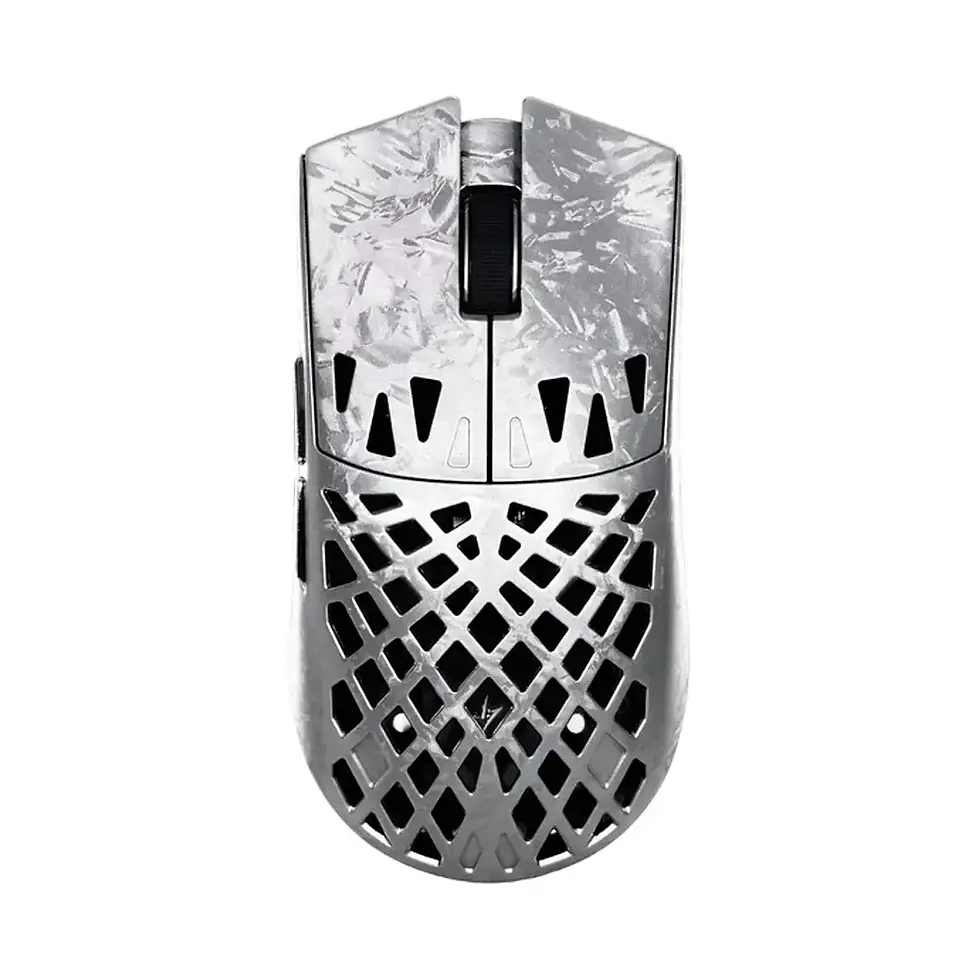
Arbiter Studio Akitsu Small (~38g)
Best for:
experienced FPS players
fingertip or aggressive claw grip
low sensitivity setups
This category offers maximum speed but minimal forgiveness.
Ultra-lightweight (40–55g)
Examples:
Arbiter Studio Akitsu Medium (~40g)
Lamzu Maya (~45g)
Lamzu Atlantis Mini (~51g)
Best for:
competitive players
users transitioning into lighter mice
This is one of the strongest performance ranges for skilled users.
Lightweight competitive (55–75g)
Examples:
Logitech G Pro X Superlight 2 (~60g)
Razer Viper V2 Pro (~58g)
Best for:
majority of serious gamers
This is the most balanced and reliable performance range.
Mid-weight (75–90g)
Best for:
mixed gaming and productivity
players who prefer control
Often overlooked, but excellent for consistency.
Heavy (90g+)
Examples:
Logitech G502 (~100g+)
Best for:
palm grip
MMO games
high sensitivity
Offers stability but slower movement.
In many cases, the issue is not only weight itself, but also setup inconsistency caused by friction, posture, humidity, desk height, or worn skates.
The Real Difference: Speed vs Stability
Factor | Ultra-Light | Heavy |
Flick speed | Faster | Slower |
Micro-adjustment | Easier for skilled users | More stable |
Fatigue | Lower | Higher |
Control | Harder to learn | Easier |
Forgiveness | Low | High |
Lightweight mice increase potential performance.
Heavier mice increase consistency and control.
Many players upgrade to lighter mice expecting instant improvement, but inconsistent glide, poor ergonomics, or worn skates often create the real problem. Our detailed setup troubleshooting guide explains why expensive gaming mice still feel bad even after upgrading.
The Most Important Insight
Weight is not always the real issue.
From real customer behavior:
most “wrong weight” complaints are actually shape-related
users often switch weight when they need:
better grip fit
correct size
different mouse pad
In practice:
shape accounts for most performance issues
weight is secondary
Complete Decision Framework
Step 1 — Game type
FPS (CS2, Valorant, Apex):
→ 40–70g
MOBA:
→ 70–90g
MMO:
→ 85g+
Mixed use:
→ 70–85g
Step 2 — Sensitivity
Low sensitivity:
→ lighter mice (40–70g)
Medium:
→ 60–85g
High sensitivity:
→ 75–100g
Step 3 — Grip style
Fingertip:
→ 35–60g
Claw:
→ 45–75g
Palm:
→ 70–100g
If you are not sure which grip you use, read our detailed guide on choosing the right gaming mouse grip to understand palm, claw, and fingertip differences.
Step 4 — Experience level
Beginner:
→ 65–85g
Intermediate:
→ 55–75g
Advanced:
→ 40–65g
Final recommendation
If unsure:
→ start with 65–75g
Then adjust:
go lighter for speed and FPS performance
go heavier for stability and comfort
Ultra-Light Mice: Why Sub-40g Exists
Sub-40g mice are designed to reduce movement resistance.
Advantages:
faster flicks
easier tracking at low sensitivity
reduced fatigue
Trade-offs:
less stability
higher skill requirement
more sensitive to surface friction
Below 50g, control becomes the limiting factor rather than hardware.
If a lightweight mouse suddenly feels unstable or inconsistent, the issue may not be the weight itself. Surface friction, humidity, desk position, and grip tension often create the feeling of “bad aim.” Read the full breakdown in our guide about why expensive gaming mice still feel bad.
Mouse Weight and Mouse Pad (Critical Combination)
Mouse performance depends on surface as well.
Mouse Weight | Recommended Pad |
35–50g | control pad |
50–70g | balanced pad |
70–90g | balanced or speed |
90g+ | speed pad |
Incorrect pairing reduces performance even with a good mouse.
Mouse weight is only one part of aim feel. If your mouse feels heavy on some days but normal on others, the issue may come from mousepad friction, arm drag or desk position — see our guide to FPS aim inconsistency and desk setup problems.
Retailer Insight
Observed patterns:
Pattern 1 — Too light too fast
Players choose ultra-light mice and struggle with control.
Pattern 2 — Safe middle range
60–75g has the highest satisfaction rate.
Pattern 3 — Shape mismatch
Most complaints about weight are actually shape issues.
The correct shape usually has a bigger impact than weight.
Where to Choose Gaming Mice
Explore available options and compare:
Gaming mice and accessories:
Full PC peripherals:
Mouse weight works together with the pad, skates and desk position. If your mouse feels too light, too heavy or inconsistent, the full setup may be the real issue. See our guide to the best FPS gaming mouse setup in 2026.
Final Recommendation
Start with a balanced setup:
65–75g works best for most users.
Adjust based on experience:
lighter for speed-focused FPS
heavier for control and comfort
Ultra-light (<50g) is best suited for experienced players who understand their setup. Now that you understand weight, the next step is choosing the right model — here’s the best FPS gaming mouse breakdown by grip, weight and playstyle.
FAQ
What is the best gaming mouse weight in 2026?
Most users perform best between 60–80g. Competitive FPS players often prefer 40–65g.
Are lighter mice better for FPS?
Yes, they allow faster movement, but require better control.
Is 35g too light for gaming?
For beginners, yes. For advanced FPS players, it can be optimal.
What weight do pro players use?
Most professionals use 50–70g, with increasing adoption of lighter mice.
Does mouse weight improve aim?
No. It changes movement behavior, not skill.
Is heavier mouse better for control?
Yes, especially for beginners and high-sensitivity users.
Best mouse weight for CS2 or Valorant?
Typically 50–70g depending on grip and sensitivity.
Should beginners use lightweight mice?
Not extremely light. Starting around 65–75g is recommended.
What matters more: shape or weight?
Shape has a greater impact on performance.
Can wrong weight affect aim?
Yes. Too light reduces stability, too heavy reduces speed.
Does mouse pad affect performance?
Yes. It changes friction and perceived control.
How to find ideal mouse weight?
Start in the middle range and adjust based on performance and comfort.



















Comments